
Your Copilot Rollout Is Not an AI Strategy
Copilot is a good tool and, for many organisations, a sensible place to start. It is not an AI strategy. Productivity improves the task; transformation redesigns the work, and most of the value sits in the manual work between people and systems.
Microsoft Copilot is a useful tool. It can make individuals faster, remove friction from everyday work and help people get more value from the Microsoft estate they already use.
But giving 500 people a Copilot licence is not the same thing as transforming a business with AI. And increasingly, we are seeing organisations confuse the two.
The pattern is familiar.
- A board decides AI is strategically important.
- The business already runs heavily on Microsoft.
- Copilot is available. Licences are purchased.
- A few enthusiastic users start using it to summarise meetings, draft emails, analyse documents and create presentations.
- Adoption metrics start to appear.
- Someone builds an AI steering group.
- A handful of pilots are launched.
And six months later, the organisation is still asking the same question.
Where is the measurable business value?
The problem is not Copilot. The problem is expecting an individual productivity tool to do the job of an enterprise AI strategy.
Copilot is good at what it is designed to do
We should be clear about this. We like Copilot. We work extensively across the Microsoft ecosystem, and for many organisations it is one of the most sensible places to begin their AI journey.
It can help employees:
- summarise long meetings
- find information faster
- draft and improve content
- analyse spreadsheets and documents
- reduce repetitive administrative work
- access knowledge more naturally
- get more value from Microsoft 365
At scale, those benefits matter. If thousands of employees each save a small amount of time every week, the theoretical productivity number can become substantial.
But there is an important word in that sentence. Theoretical.
Saving someone 20 minutes does not automatically create 20 minutes of value for the business. It might make their day easier. It might improve the quality of their work. It might reduce frustration. All of those things are worthwhile.
But unless that capacity is deliberately converted into higher output, reduced cost, increased revenue or improved customer outcomes, the financial impact can be difficult to see.
That is where the distinction between AI productivity and AI transformation matters.
Productivity improves the task. Transformation redesigns the work.
Imagine a finance administrator spends two hours every day moving information between systems. Give them Copilot and they may become faster at writing emails, producing commentary and reviewing documents. Useful.
But the underlying process still exists.
- The information still moves manually.
- The approval still waits in an inbox.
- The employee still has to open three systems.
- The customer still waits for somebody to complete the task.
AI transformation asks a different question.
Why does a person need to perform this process at all?
- Could an AI agent monitor the inbox?
- Could it extract the information?
- Could it validate the data against internal policy?
- Could it update the relevant systems?
- Could it request missing information?
- Could it escalate exceptions to a human?
- Could it produce the reporting automatically?
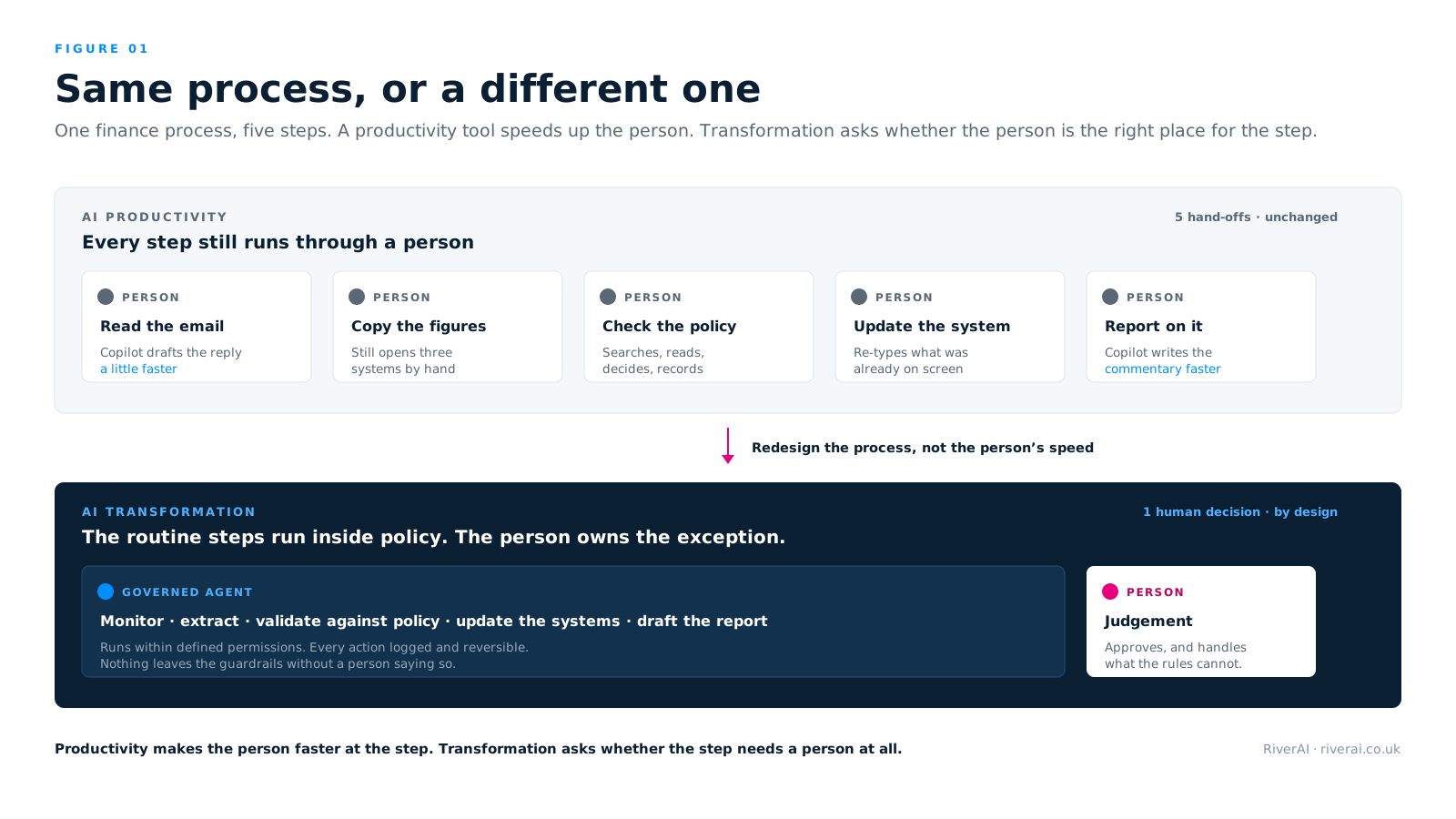
Now we are not making the employee slightly faster. We are redesigning the operating model. That is a very different proposition.
The biggest AI opportunities usually sit between people and systems
Most organisations are full of what we call human middleware. People spend enormous amounts of time:
- copying data from one system into another
- chasing colleagues for information
- reading documents and updating records
- checking whether something has happened
- reconciling two sources of information
- preparing routine reports
- moving work from one queue to another
- sending status updates
- reviewing straightforward cases that only occasionally require judgement
These activities exist because historically software could not understand context well enough to perform them. That is changing. Modern AI can read, reason, decide, communicate and interact with enterprise systems.
That means some of the greatest opportunities are not inside Word, Outlook or PowerPoint. They sit between your applications, your processes and your people. And that is where an enterprise AI strategy needs to go.
A licence rollout answers the wrong question
A Copilot programme often begins with: who should have access to AI?
A proper AI strategy begins somewhere else.
Where does work happen in our organisation, and where could AI materially change the economics of that work?
Those are fundamentally different questions. One is a technology deployment question. The other is a business design question.
A meaningful AI strategy should examine things like:
- where labour is concentrated
- where customers experience delays
- where teams repeatedly move information between systems
- where manual decisions follow predictable rules
- where demand is constrained by human capacity
- where revenue is lost because processes are too slow
- where errors create downstream cost
- where employees are performing work that software could increasingly perform
Only then should the conversation turn to technology. Sometimes Copilot will absolutely be part of the answer. Sometimes an AI agent will be. Sometimes traditional automation will be better. Sometimes the right solution will combine all three.
The strategy should determine the technology. Not the other way around.
The real opportunity is Human + AI
The most interesting organisations are moving beyond the idea that AI is simply a tool every employee should use. They are starting to redesign work around a combination of humans and AI.
Humans retain the things we are exceptionally good at: judgement, empathy, creativity, negotiation, leadership, relationship building and complex decision-making. AI takes on more of the repeatable digital work around those activities: reading, checking, searching, updating, routing, drafting, monitoring, reconciling, coordinating and executing.
The result is not necessarily fewer people. It is often far more capacity from the same organisation.
- A sales team can spend more time speaking to customers.
- A mortgage broker can spend more time giving advice.
- A finance team can spend more time analysing performance.
- A recruiter can spend more time speaking to candidates.
- A service team can spend more time solving genuinely complex problems.
That is where AI begins to change the economics of a business rather than simply improving individual productivity.
Copilot should be part of the strategy, not the strategy itself
For many organisations, Microsoft Copilot should absolutely have a place in the AI landscape. It is accessible. It is embedded into familiar tools. It can help create AI literacy across the workforce. It gives employees a relatively simple way to experience the benefits of generative AI. And it can deliver meaningful improvements to individual productivity.
But it should sit alongside a wider programme that asks a much bigger question.
How would we design this business if AI were available when our processes were originally created?
That question leads somewhere much more interesting. It leads to processes being redesigned. Systems being connected. AI agents being introduced. Human roles changing. Governance evolving. New operating models emerging. And ultimately, measurable commercial outcomes.
Measure outcomes, not licences
There is also a measurement problem.
AI programmes often report:
- Copilot licences deployed
- active users
- prompts submitted
- training sessions completed
- adoption percentages
Those are useful implementation measures. But they are not business outcomes. Boards ultimately care about things like:
- Did revenue increase?
- Did the cost to serve fall?
- Did customers get a faster response?
- Did employees gain meaningful capacity?
- Did errors reduce?
- Did the business avoid additional hiring?
- Did conversion improve?
- Did the process become faster or more scalable?
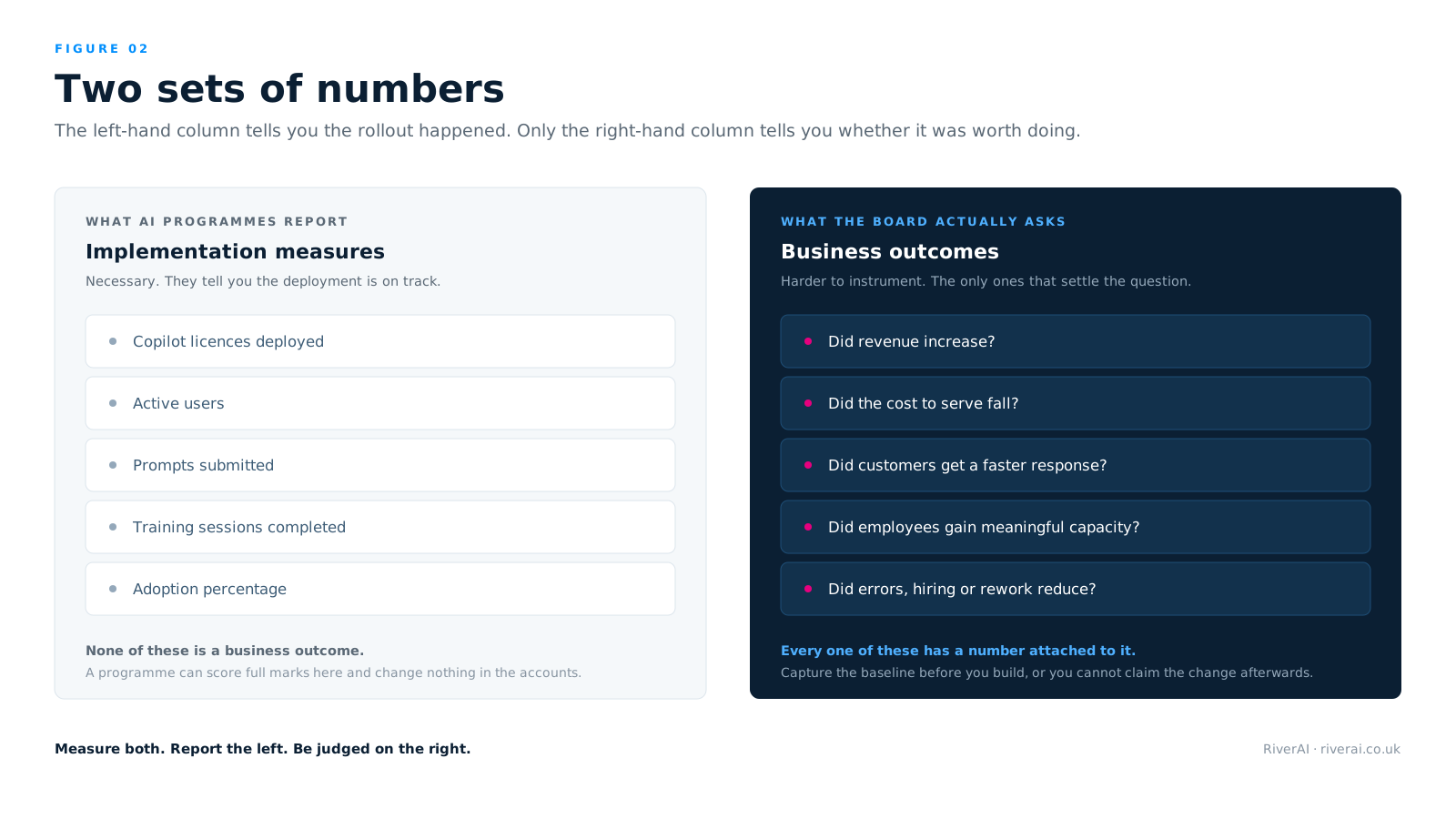
If your AI programme cannot eventually connect itself to those questions, it risks becoming another technology adoption initiative. And AI has the potential to be much more important than that.
Start with the business, not the licence
Copilot can be a very good starting point. But it should not be the finishing line.
The organisations that generate the greatest value from AI will not simply give employees better tools. They will redesign the way work gets done.
- They will look beyond individual productivity and into end-to-end processes.
- They will identify where humans are acting as the connective tissue between systems.
- They will introduce AI where it can genuinely change capacity, cost, speed or customer outcomes.
- They will build an operating model capable of governing and improving those systems once they are live.
So yes, roll out Copilot. Train people to use it properly. Encourage experimentation. Build AI literacy. Measure adoption.
But do not mistake that for the strategy.
Because the biggest opportunity in enterprise AI is not helping your people do the same work slightly faster. It is redesigning the work itself.